Thursday, August 27, 2015

What to do about churches? (part one)

St. Patrick's Church, Kinkora

The beautiful country churches we saw on the tour last time are not listed or designated under the Ontario Heritage Act.  Interestingly, however, St. Patrick’s, Kinkora, is designated as one of seven “cultural heritage locations” under the County of Perth’s Official Plan. (Note 1)

Is it just me or does the inclusion of a definitive list of cultural heritage sites in an Official Plan seem like a bad idea?  At the same time it’s a bit shocking that there are only seven — three of them churches — in the whole county.  (Reminds me of the Woody Allen joke at the beginning of Annie Hall where a hotel guest says, “The food here is terrible!”, and her friend replies, “Yes, and such small portions.”)

Something else jumps out.  The Official Plan says:

All alterations to, or demolitions of, buildings, structures and sites designated "Cultural Heritage", or designated under the Ontario Heritage Act, must receive approval of the local municipal Council.

Mmmn… this means that alteration or demolition of St. Patrick’s, which is on the list but not designated under the OHA, would nonetheless require the approval of the local council.  Almost certainly not kosher!  The courts have frowned on municipalities using Official Plans to regulate property when they have specific legislative tools to do so, something we’ll look at in a future post for its implications for heritage protection.

But back to churches.  And the question of how public policy in Ontario has responded to the challenges to their preservation.

Maybe we start here…  it’s 1980 and the board of the Ontario Heritage Foundation (now the Ontario Heritage Trust) is meeting in Toronto.  I’m in the room as a new staff member.  The board is wrestling, again, with a particularly thorny question — what to do about the adamant refusal of churches, or rather their owners, to accept OHF grant money for restoration and repair.  While eager for the funding, the church owners won't agree to a major condition that comes with it: that they enter into a heritage conservation easement agreement with the OHF for a very long term, the longest in fact — perpetuity.

Some context.  The Foundation’s innovative easements program had been steaming along pretty happily since it was set up following the passage of the Ontario Heritage Act in 1975, when the OHF and municipalities got the ability to acquire heritage easements.  The program went hand-in-hand with the Foundation’s then-healthy capital grants program.  Beyond undertaking to do funded work according to conservation principles, recipients of grants also had to agree to certain conditions designed to protect the property (and the public investment in it) into the future.  These were typically municipal designation and an OHF easement.  Remember that not until 2005 did municipal designation permanently protect against demolition.  By contrast, the heritage easement mechanism was air-tight in that respect, and the Foundation’s standard agreement provided that it would run “in perpetuity.”

But, though it may seem a little ironic, church organizations did not at all like the idea of “forever” when it came to agreements limiting what they could do with their buildings.  They wanted something much, much shorter — say 25 years.  (Had this idea been accepted, many of the Ontario Heritage Trust easements on churches would now have expired!)

After much debate the Foundation’s board voted in the end to make an exception for churches, and require easements for 99 years rather than in perpetuity.  Whether it was otherwise defensible to treat places of worship differently from other types of heritage property, the decision produced a good result.  Most if not all church applicants accepted the compromise and signed agreements for 99 year terms.  The money flowed and churches were saved, and protected, which might not have been. 

One of the first churches to benefit was Assumption Church in Windsor (its easement, which includes protection of the magnificent interior, would still have about 65 years left to run).


Assumption Church, Windsor

Assumption Church interior


That board meeting stands out in my memory as the first time I made a “policy” pitch to the members of the Ontario Heritage Foundation (I argued for the 99 year option).  One of those members was Anthony (Tony) Adamson, a restoration architect and co-author of Hallowed Walls.  While having his say in the churches discussion, Tony amused himself doing what architects often do — doodling.  On the back of an agenda paper, retrieved by me later as a souvenir of the day, here is what he drew.
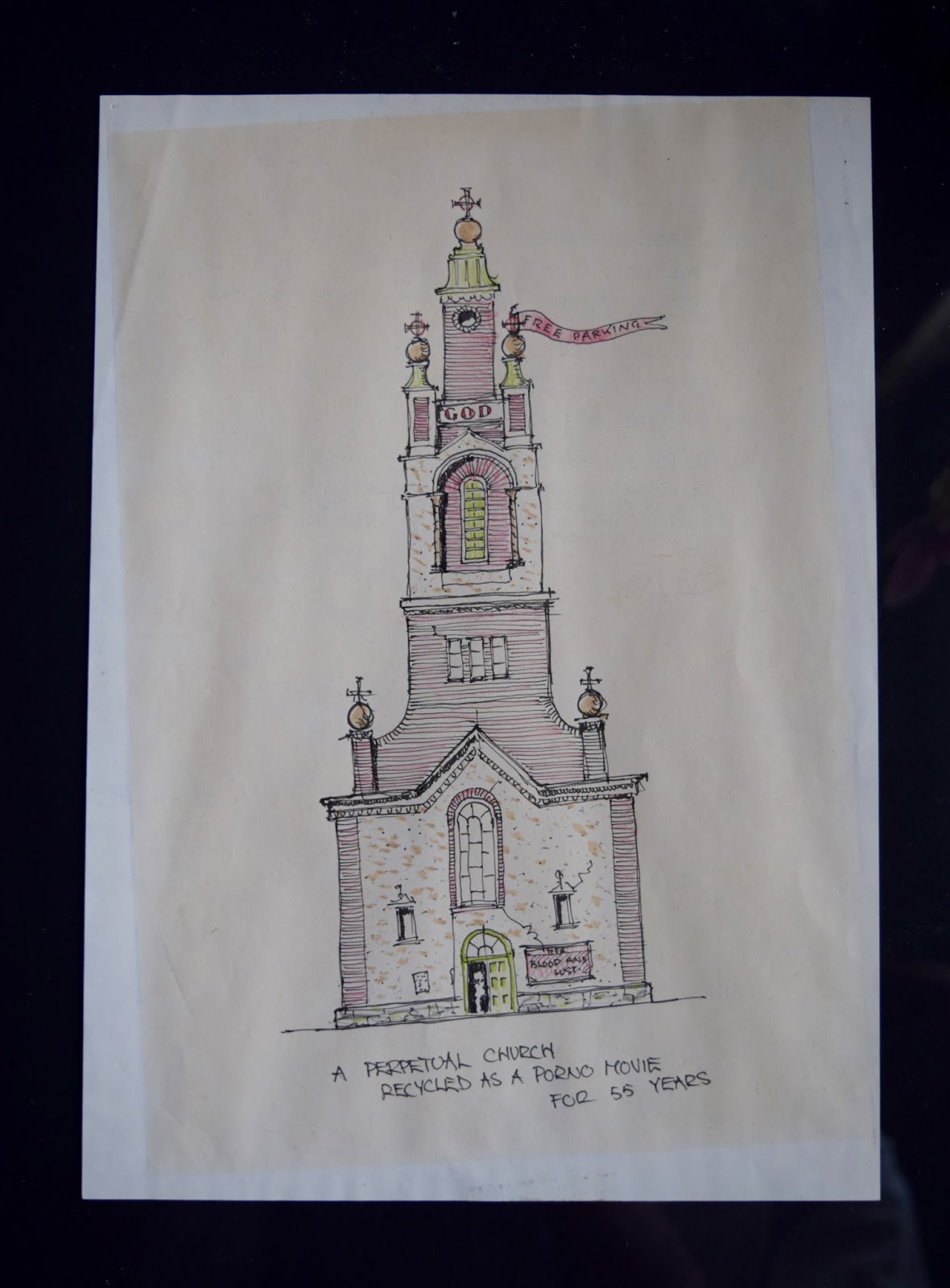
Anthony Adamson's sketch of a church, created during a 1980 OHF board meeting


Tony Adamson’s comical sketch, whimsically captioned “A perpetual church recycled as a porno movie [house] for 55 years”, suggests not just the provincial debate about the term of church easements but also the issue of the adaptive re-use of redundant churches.  More on this and the particular predicament of our heritage places of worship next time.

Note 1: The Official Plan covers all of the county with the exception of Stratford and St. Marys, which have their own OPs.  The list of cultural heritage sites dates from the last update in 2007.

Thursday, August 13, 2015

Churches -- a country tour


Rose window, St. Patrick's, Kinkora


Another Ontario heritage anniversary.  Forty years ago, in 1975, Marion MacRae and Anthony Adamson published their groundbreaking Hallowed Walls: Church Architecture of Upper Canada.  In the Prelude they wrote:

They had … faith and they built for it, places of worship which were temples of the spirit, social centres of the growing communities and, all too frequently, the only buildings in which they could afford the luxury of beautiful space.  It would be an irreparable mistake to let buildings which played so vital a role in the social history of the province disappear without record or comment.


Churches, places of worship — for the preservationist another weighty topic, right?  So let’s ease into it.  I’ll start by taking you on a little pictorial tour of three country churches in this part of the world (Perth County).  Unlike many, these churches — or at least the buildings — seem to be doing just fine.

Avonbank Presbyterian Church

One of my favourites, this little church is in a tiny place called Avonbank (not to be confused with nearby Avonton, and certainly not Avonlea!).  Constructed in 1890 as a Presbyterian church, it has a quiet simplicity and grace.  Its congregation long ago combined with that of Motherwell Presbyterian, a few miles away, and the building today is used rarely — for one annual service, a candlelight carol celebration at Christmas and for the odd wedding or special event.  But, as you see, it is well-maintained and someone has planted the flower pots beside the door.

The adjacent cemetery has four very handsome fieldstone gateposts.  These are from 1929, which seems to have been a time, in these parts at least, when the second and third generations began to publicly commemorate the achievements of their settler forbears.  The sentiments this evoked are beautifully captured on plaques on two of the gateposts.


Several miles to the north, on Highway 8 — the old Huron Road — is Seebach’s Hill and First St. John’s Lutheran Church.


First St. John's Lutheran Church, Seebach's Hill, with cemetery entrance and corner of buggy barn to right

The church, built in 1927, replaced earlier ones on the site.  It too has a cemetery (special to me because my Schneider great-grandparents are buried there).  Note that the cemetery entrance, visible to the right, has very similar fieldstone gateposts to Avonbank’s — the same craftsman? — this time with the date 1931.


But the really remarkable thing about Seebach’s Hill is the church’s old buggy barn.  I have never seen one like it.


Old buggy barn, St. John's Lutheran Church, Seebach's Hill

The huge barn — 260 by 54 feet! — clearly belonged to the old church but has somehow survived and become… a car barn.  How many other rural churches do you know that have covered parking?  And, by the way, is this still religious heritage or something else?  Is this a case of adaptive re-use or just continued use accommodating changing technology?


Buggy barn interior

Just up the road, on the way to our last stop in Kinkora, we’ll stop to admire the striking circular cairn to Andrew and Eva Seebach.  Seebach — like Sebastian Fryfogel, who built the iconic Fryfogel Tavern to the east of Stratford — had one of the early settler inns on the Huron Road.  Mmmn… more fieldstone work, dated 1928, the centenary of the opening of the Huron Road and the Seebachs’ arrival here.

Seebach cairn

A couple miles north, almost lost in the cornfields, is the quiet hamlet of Kinkora — in Gaelic Kinkora means “place of beauty.”  While the Roman Catholic church here is, not surprisingly, St. Patrick’s, what is surprising is the grandeur of the church.  It’s a stunner!


St. Patrick's Roman Catholic Church, Kinkora

The church, from 1882, is in fact the work of noted Ontario ecclesiastical architect Joseph Connolly.  Connolly is perhaps best known for the majestic Basilica of Our Lady Immaculate that dominates downtown Guelph.  How the local Irish farming community managed to lure Connolly to this unlikely spot — and pay for this sumptuous building — is a story I have yet to discover.  Unlike the limestone Guelph church, Kinkora is of brick, in polychromatic High Victorian Gothic.  The interior is sublime and and the building has a very pretty separate side chapel.  Alas, the spire on the tower, visible for miles across these flatlands, had to be taken down a decade or so ago, although there are hopes it may be reconstructed.


Several years back, after the church was part of a local Doors Open, attracting a wider audience and more attention, St. Patrick’s received an award from Architectural Conservancy Ontario for the efforts of the parish in restoring and maintaining this marvellous structure.  Talk about the “luxury of beautiful space.”

St. Patrick's, Kinkora interior

These three churches — and their associated cemeteries, gates and buggy barns — are lucky to survive and continue to be lovingly preserved by their communities.  None is listed or designated under the Ontario Heritage Act.  Should they be?  Of course — we’ll get into this and more thoughts on the protection and preservation of religious heritage next time.


Quatrefoil stained glass window, St. Patrick's, Kinkora

By the way… thanks for reading!

Monday, July 27, 2015

Protecting municipally-owned heritage (part two)

When we looked at the need for policies to protect heritage property owned by the province, we saw that the demolition of the old lunatic asylum in Toronto in 1976 was perhaps a watershed moment (see “Policies for the protection of provincially-owned property (part one)”, from May 31, 2015).

In the case of municipally-owned heritage, there are a couple losses that loom particularly large in the last 50 or so years.  The first was in Kitchener, where the splendid 1920s classical revival-style city hall was demolished in 1973.  The building presided over a great civic square, which was also lost — both replaced with a non-descript mall. (Note 1)


Old city hall and civic square, Kitchener


The other was in Chatham in 1981 when the grand old Harrison Hall, Chatham’s city hall, fell to the wrecker’s ball.  I remember the consternation this caused at the culture ministry in Toronto at the time.  The OHA had been passed in 1975 and the revamped Ontario Heritage Foundation (now Ontario Heritage Trust) had grant money for preservation projects.  But despite provincial and local efforts, council was not persuadable.  Again, a mall rose from the ashes.


Harrison Hall, Chatham


Then there are the famous “they-beat-back-the-philistines” stories from the 1960s and ‘70s — the saving of old city hall in Toronto is the best known.  (In this case another downtown mall, the Eaton Centre, did not end up swallowing the building.)  The 1899 neo-Jacobean (or Picturesque, take your pick) city hall in Stratford, and its triangular civic “square”, also narrowly escaped destruction in this period. (Note 2)


Stratford City Hall from the rear showing part of Market Square


More recently, we have seen notable successes in rescuing civic buildings that were at risk, often as a result of amalgamations.  My favourite is Victoria Jubilee Hall — the fight to save Walkerton’s old town hall gave birth to the local branch of Architectural Conservancy Ontario and ACO now owns the building.


Victoria Jubilee Hall, Walkerton (you can probably guess its date of construction)


What do we learn from all this about how to protect municipally-owned heritage?

First, use of listing and designation is crucial.  Even more so than with private property, as municipalities should be leading by example.  Listing flags a heritage property and provides interim protection.  Designation provides long-term protection.  While it’s true, as we saw last time, that with these powers the municipality ultimately controls the levers, it must still follow the process set out in the OHA.  It must at least consult with, and consider the advice of, its municipal heritage committee.  In the case of de-designation (almost always a bad idea), its actions are also subject to review by the Conservation Review Board if there are objections (which there almost always will be).  While it cannot be appealed, demolition of a designated structure is not something any city, town or township would contemplate lightly.  Even alterations will be subject to sharp scrutiny.  Here in St. Marys the Town proposed removal of a chimney of the designated town hall, creating a big fuss — and hasty back-pedalling.

Heritage district designation can be a powerful way of protecting and enhancing the municipally-owned “public realm” of an area — the streets, sidewalks, verges, etc. that contribute to its unique character.  (Alternatively, or in combination with an HCD, some municipalities, like Kingston, use area-specific Official Plan policies for this purpose.)

Second, the importance of strong heritage policies in the municipality’s Official Plan  deriving from and building on those in the Provincial Policy Statement.  These should include special additional policies that apply to heritage property in municipal ownership and public realm property.  Here are two examples from Toronto’s recently adopted OP heritage policies:

  • When a City-owned property on the Heritage Register is no longer required for its current use, the City will demonstrate excellence in the conservation, maintenance and compatible adaptive reuse of the property.
  • When a City-owned property on the Heritage Register is sold, leased or transferred to another owner, it will be designated under the Ontario Heritage Act.  A Heritage Easement Agreement will be secured and monitored, and public access maintained to its heritage attributes, where feasible. … (Note 3)

Third, don’t expect the province to come to the rescue of civic heritage at risk.  While I would like to believe the old Kitchener City Hall and Chatham’s Harrison Hall would still be standing if the OHA had had the provincial designation and stop order powers it does today… well, that’s hypothetical, but also fanciful.  (That said, a timely provincial stop order should not totally be ruled out, and sometimes all it takes to turn the tide is a little extra time.)

Not to be overlooked is the Ontario Heritage Trust’s heritage conservation easements program, which further protects many municipally-owned structures such as Stratford City Hall and the Wellington County Courthouse in Guelph. (Note 4)  The province — both the Ministry of Tourism, Culture and Sport and the Ontario Heritage Trust — is of course also a great resource and active promoter for the municipal policies and actions discussed above.  And then… there’s provincial public infrastructure funding!

Finally, and most especially, the role of citizen vigilance and activism, which has effectively preserved so much of our civic (and non-civic) heritage, often through hard-fought battles — whether for the town hall on the square, the bridge on the river or the by-law or policy on the books.

Note 1: Kitchener’s decisions here were approved by public referendum.
Note 2: Architectural historian Douglas Richardson memorably referred to Stratford City Hall fitting into Market Square ”like a hand in a glove.”
Note 3: Policies 8 and 9 under “General Heritage Policies.”
Note 4: The Trust’s easements program is generally a reactive, rather than proactive, one, and because of funding limitations has become over the years less focussed on cultural heritage and more on natural heritage.

Next time: Churches!

Thursday, July 16, 2015

Protecting municipally-owned heritage (part one)

How much of our heritage is in municipal ownership?  Think about it — historic city/town halls, libraries, museums, parks, cemeteries (lots!), war memorials.  PUC (public utility commission) and like buildings.  And most bridges.  Don’t forget roads.  What else?

PUC building, now Festival Hydro, Stratford

Some municipally-owned properties have been acquired from other governments or agencies, often because they were redundant — old courthouses, railways stations, and railway rights-of-way are common examples.  Sometimes surplus schools too (schools are owned by school boards).


Junction Station, St. Marys -- one of two stations owned by the Town

Then there are private properties that municipalities acquire, often by expropriation, for various purposes.  The power to acquire property for “community improvement” goals under the Planning Act is well known.  (Believe-it-or-not there is even a power under the Ontario Heritage Act to expropriate property for heritage conservation objectives, but this has been used, to my knowledge, only once, in Amherstburg in the early ‘80s.)  In many cases these are “pass through” properties that are later sold back to the private sector or another broader public sector owner.

In the arsenal of tools to protect cultural heritage resources at risk, public ownership is touted as an important one.  The idea that, relative to an irresponsible private owner, a public owner will be better disposed to recognize the public interest in preserving the property or better able to marshall the resources to do so, or both, is — in general — true.

At the same time we all know that public ownership provides no guarantee of enlightened stewardship of heritage sites — especially in a time of ever greater belt-tightening.  And so there is need for good policies and other measures to provide some assurance this will happen.

For municipally-owned sites, what are these?  Well, first, the Provincial Policy Statement (PPS), issued under section 3 of the Planning Act, which unequivocally directs that “significant” cultural heritage resources be conserved (section 2.6).  As a statement of overarching provincial policy objectives, the PPS is a powerful instrument, and, as intended, can be quite effective in prompting municipalities and other authorities to adopt what might be considered subordinate, implementing policies and actions to protect cultural heritage.  These measures include strong Official Plan policies and the use of tools provided in the Ontario Heritage Act and other legislation.

Reliance on the PPS to protect specific properties, however, would be problematic.  For one thing, it is triggered only with respect to a “planning matter” — arguably how a town, say, preserves (or not) the cultural heritage values of its Carnegie library falls outside its purview. (Note 1)

Designation under the OHA is the usual way of protecting heritage property in municipal hands.  Municipalities are in fact much more likely to designate their own properties than to designate private property, especially where the owner is reluctant.

But in this situation heritage designation is less secure than usual.  Inherent in the (largely) decentralized system created by Ontario Heritage Act is the idea that the decisions about a community’s heritage rest with the local municipal council.  However, where the municipality is also the owner of the heritage property in question… well, you can see how a council might be conflicted.  When faced with a recommendation from its municipal heritage committee to designate a library, for example, the council may choose to designate, or, for self-interested reasons, decide not to.  Or, having designated, the council may decide to approve whatever alteration or demolition the municipality wants to make.  Or even to de-designate.  A cynic might say it looks a little like the fox guarding the hen-house!

Some jurisdictions have a body separate from municipal council — usually a preservation board like the New York City Landmarks Preservation Commission — that decides on designations and approves changes to protected property.  (Over the years there have been suggestions that municipal heritage committees, which are advisory only, should be beefed up and assume similar powers.)

Enough for today… more next time.

Note 1: The PPS has other limitations: the qualifier “significant” in the section 2.6 policies is problematic; and there is also the “read it as a whole” injunction which in practice may have the effect of weakening any one specific policy.  For another day.

Wednesday, July 1, 2015

Carnegie libraries, our communities' public buildings ... and Alice Munro?

This rambling “policy story” begins in my hometown of Milverton, Ontario, north of Stratford — on the edge, as I now like to say, of Alice Munro Country.  And speaking of things literary, like many small and not-so-small towns Milverton has a Carnegie library.


Former Milverton library


Built in 1909 this stately structure saw a century of service from 1910 until it closed in 2011.  I loved the old library as a kid — it was the grandest public building in town (village actually, population about 1100). That impressive flight of stairs, from the top of which which you looked down and across Main Street and further down a street that ran up to the library.  (I didn’t know what an axial view was then, just that it was special.)  The comforting, almost reverential feeling inside — the high-ceilinged rooms with all those books and, of course, the pervasive quiet.  I can still see the shelf where the Oz books resided, and the one with the Hardy Boys books too… but I digress.

The library was also the town hall — the village council met for decades in the lower storey of the building.  In the amalgamation wave that swept the province in the late 1990s Milverton joined with four neighbouring townships to become the Township of Perth East.  The new township needed a new municipal building (I know, doesn’t sound as good as town hall, does it?), and later a new library.

But let’s go back a ways to get the bigger picture — and this brings more public buildings, namely schools, into the mix.  In a tale of dominoes all too common in our communities, here is what happened in Milverton.  The late 1960s-early 1970s saw an earlier amalgamation tide hit Ontario schools, and the Milverton high school was closed (and students bussed to Stratford and Listowel).  But the building was at least re-used as the area public school, although that resulted in the closure of smaller schools round about.  The old, handsome but decrepit Milverton public school became for a while the village/township hall and the council met there instead of the library.  Then the new municipality demolished the old school and built its new municipal offices, which of course also meant that the four former township halls were made surplus.  And then the library was replaced with a new one on a different site, leaving the old building intact but surplus, its fate uncertain too.

Now many municipalities have done a great job of keeping their Carnegie libraries and adapting them to meet current needs.  (Bear with me, I’ll get to the point of all this, eventually).  For example — Brussels, Ontario, in the present Township of Huron East (and the heart of Alice Munro Country), recently enlarged and renovated its Carnegie library, which is the same age as Milverton’s and has some stylistic similarities.  Local architect John Rutledge designed a sympathetic addition while sensitively refurbishing the original building.  When I visited it last month the librarian said that Alice Munro had toured the library the week before and really liked it.  Reminds me that the Wingham library, also a heritage building, was just renamed to honour our Nobel Prize winner… but getting sidetracked again.


Old postcard -- sorry don't have pic after major renewal 

But the Brussels approach would not have worked in Milverton.  More space was needed and, as the photo shows, the site was confined, with houses on either side.  And all those steps — wonderful for views, yes; for accessibility, not so much.  Parking also in short supply.  The new library solved these issues.

It seemed for a while like the old library was at risk.  Our local Architectural Conservancy Ontario branch was concerned.  But fortunately it was purchased by an individual who uses it as a residence and office and is maintaining it nicely.  From public library to private home... but apparently a good example of adaptive re-use.

Did I mention that none of the public (in one case now private) buildings I’ve mentioned is designated under the Ontario Heritage Act?

Next week: protecting municipally-owned heritage

Monday, June 22, 2015

Ontario Place — a special place... and case!

First, before heading on down to the Lake Ontario waterfront, some context.  My two previous posts tell the story of how Ontario ended up with a different protection regime for cultural heritage property in the hands of the Crown.  Provincial standards and guidelines, developed and made mandatory under Part III.1 of the Ontario Heritage Act, now apply to all provincial ministries, as well as to other “public bodies” prescribed in regulation.  To keep things clear, the designation regime under Parts IV and V of the Act does not apply to these public owners.

A big policy question was what public bodies should be “caught” by the new approach.  “Public bodies” is not defined in the legislation and in theory could cover a huge swath of public owners, taking in what is often called the MUSH sector — municipalities, universities, school boards, hospitals, etc.  But a major consideration was that, if public sector properties were brought into the net, it would have the result of excluding them from municipal designation.  In the extreme case this would leave municipalities with only private property to designate!  And what would be the status of town halls, libraries, schools and so on already designated?

So no surprise that it was decided this was just way too far to go.  Rather, since the primary policy intention of the new regime was for the province to “lead by example”, the list of public bodies would be narrowly focussed on Crown agencies and corporations.  And, again to minimize the impact on designation approaches, the list would not catch agencies with a single site, but only agencies with property in different municipalities, so as to ensure a consistent standard of care across their property portfolio.  The St. Lawrence Parks Commission?  Caught.  The Royal Ontario Museum?  Not.

And now we come to Ontario Place, the iconic Toronto landmark owned by the Ontario Place Corporation (OPC), an agency of the Ministry of Tourism, Culture and Sport.  One site, so not caught, right?


Well, not at first.  But earlier this year the government amended Regulation 157/06 (the regulation listing public bodies subject to Part III.1 of the OHA) to add the OPC.  The reason, MCTS said, was to make it clear “about who is responsible for the identification and management of any cultural heritage resources associated with Ontario Place.”

As most will know, Ontario Place, opened in 1971, is in the middle of a major renewal.  While a single property, the site is a large and complex one — a waterfront urban park — with a wealth of resources, cultural and natural.  Cultural heritage values clearly need to be identified and protected as an integral part of revitalization plans.  Bringing Ontario Place within the ambit of Part III.1 of the OHA, and the standards and guidelines regime it provides, seems a smart way to go.

To develop the site’s Statement of Cultural Heritage Value (SCHV) and identify its heritage attributes, the province — in what by all accounts was an exemplary process — set up a heritage review committee with both provincial reps and external heritage advisors. Here is a little of what they came up with:

Ontario Place, a cultural heritage landscape, remains a rare and intact Modernist expression of integrated architecture, engineering and landscape that honours and incorporates the natural setting of Lake Ontario. It was a remarkable and ambitious achievement of late twentieth century architecture, and holds an enduring influence in Toronto, the province and internationally.

See the full SCHV and description of heritage attributes at 

In July 2014 Michael Coteau, Minister of Tourism, Culture and Sport, announced the SCHV as part of the province's long-term vision for revitalization of Ontario Place.

Tamara Anson-Cartwright, former MCTS staffer who played a pivotal role as advisor on the project, says: “It was an incredible experience and one of the proudest moments of my career with the province.”

The SCVI has already proved useful in assessing heritage impacts as part of the environmental assessment of the Ontario Place Urban Park and Trail, a first step in revitalization.  It was also handy in obtaining Minister's consent for the removal of a non-heritage building on the site — the provincial standards and guidelines require the consent of the Minister of Tourism, Culture and Sport for the demolition of structures on heritage properties determined to be of provincial significance.  The SCVI will also be invaluable in preparing a long-term conservation plan for the site, as also required, and in continuing to help inform and guide the revitalization and re-imagining of Ontario Place.

Kudos all round!

Next time: What about municipally-owned heritage property?

Wednesday, June 10, 2015

Policies for the conservation of provincially-owned property (part two)

As we saw last time, the 1975 Ontario Heritage Act made no provision for the protection of provincially owned heritage property.  Bilateral agreements had been struck between the culture ministry and a few of the main property-owning ministries and, later, the Crown agency that was created to manage much of the government’s property — the Ontario Realty Corporation.  But these arrangements were limited in their scope and certainly in their clout.

Efforts to overhaul the Ontario Heritage Act provided an opportunity to address the issue through legislative change.  In 2002, under Premier Ernie Eves, David Tsubouchi was appointed Minister of Culture.  The minister was (yes!) keen on heritage and, thanks to him, the long-stalled reform of the OHA got going again.  But, fortuitously, he brought something more to the (cabinet) table.  The new Minister of Culture also happened to be the powerful Chair of Management Board of Cabinet and the minister for Management Board Secretariat, which was responsible for the Ontario Realty Corporation.  You see where this is going…

Meanwhile, back in the policy shop, there was a big push to respond quickly to the new interest from the minister’s office.  Old proposals for changes to the Act were dusted off and given a re-think.  Most held up, but some — like what to do about the protection of the Crown’s heritage property — not so much.

As usual in this situation, one looks to what other jurisdictions do.  Most other provinces, with a more centralized approach to heritage than Ontario’s, had legislation that was binding on the Crown and included provincial heritage designation.  This meant that provincially owned property could be designated by the province, which in turn meant, in most cases, the minister responsible for heritage.  Seems logical, but how had this worked out?

Not so well.  There were designations of Crown heritage property but they were relatively few, and were usually the result of negotiation between government ministries/departments.  This latter point makes sense when you think of it.  Following this approach one minister (the culture minister) is essentially designating another minister’s property!  The tension — and potential resistance — in the situation is obvious.  Throw in that in most provinces, as in Ontario, the culture minister is likely not a cabinet heavyweight.  Maybe not the best way to go.

What about the feds?  They have a Federal Heritage Buildings Review Office (FHBRO).  This seems a stronger and more comprehensive model, with federal departments’ responsibility for their heritage backed up by a Treasury Board policy.  But it is also a centralized one, with the designation of heritage property by the Minister of the Environment and FHBRO undertaking heritage evaluations as well as other work.  The regime also does not apply to federal Crown corporations.  Some good things here, but the right fit for Ontario?

In addition to researching how other jurisdictions deal with your particular policy issue, it’s equally important to look at how your own deals with different but analogous issues (even if sometimes the parallel is not apparent).  Ontario as it turned out had one very recent major initiative that influenced the final policy outcome here: the Ontarians with Disabilities Act, which became law in late 2001.  The key take-aways from this legislation were that it applied government-wide, it mandated guidelines to be followed, and it was mainly self-implementing, i.e. not needing a central “review” office.

So… on the question of how to protect Crown-owned heritage property what was developed was a proposal for legislative authority to develop standards and guidelines to apply to all ministries and to other “public bodies” as well.  To avoid overlap and ensure clarity as to which protection regime applied, property of these owners would not be subject to designation under Parts IV and V.

Easier said than done.  But, thanks in no small measure to their shared minister, David Tsubouchi, the “little” Ministry of Culture was able to get the “big” Management Board Secretariat and Ontario Realty Corporation on side.  The bill to amend the Ontario Heritage Act introduced in 2003 included a whole new part of the Act: Part III.1, “Standards and Guidelines for Provincial Heritage Properties.”  While that bill died when the October 2003 election was called, a virtually identical provision was part of the new government’s Bill 60 and became law in 2005.

While this was a huge accomplishment, there were still the small matters of actually developing the standards and guidelines in consultation with affected ministries, getting them approved by cabinet, and deciding on what public bodies they would apply to.  This long and difficult process (a story in itself) took another five years!

But, finally in April 2010, success.  Cabinet approved mandatory standards and guidelines applying to all ministries and to 14 Crown agencies and corporations listed in regulation (Regulation 157/10, since amended).  While the regime is largely self-implementing, the culture ministry has an oversight function and a role in approving ministry/agency evaluation processes (what’s heritage, what’s not) and certain decisions about heritage property of provincial significance.  (Read the standards and guidelines for yourself at: http://www.mtc.gov.on.ca/en/publications/Standards_Conservation.pdf.)


Then, of course, the implementation began!  While off to a slow start, going pretty well, from all reports…

Next time: something cool about Ontario Place!