Friday, September 25, 2015

What to do about churches? (part three)

Stained glass dome, Highgate United Church, now Mary Webb
Cultural and Community Centre, Highgate 

There’s something else about churches…  

Back to basics for a minute.  Built heritage conservation is not supposed to be about use (as long as there is a viable one of course!).  So whether an old factory is used for its original industrial purpose, adapted for commercial use or turned into chic condos is all the same — right? — provided its heritage features are identified and respected along the way.  Heritage is about the fabric or “bricks-and-mortar,” the physical features of the place; while what takes place within/on that fabric/property — the way it is used — is pretty much irrelevant.

This at any rate is the premise of our chief tools for legal protection — heritage designation and heritage easements under the OHA.  They do not in themselves restrict (or permit) the use that can be made of a property or place.  Zoning, our basic land use planning mechanism, does that.

And yet, we do accept that a heritage structure continuing in its original use is the best of all scenarios.  From the Appleton Charter:

Use — A property should be used for its original purpose. If this is not feasible, every reasonable effort shall be made to find a compatible use which requires minimal alteration. … [Note 1]

So continuing original use is almost always preferable to adaptive re-use.  Why?  Obviously it’s simpler, less complicated.  Adaptive re-use involves, well, adaptation and intervention — physical changes which may have an impact on heritage attributes.  But it’s more than that.  Something else inevitably melts away when an old building is repurposed (as we now like to say) and its traditional use ends.  Something intangible.  Hard therefore to nail down, but having to do with a heightened sense of place, nearness of the past, consciousness of continuity.  Sometimes we call this, rather inadequately I think, authenticity.

Nowhere is this more the case than with churches, places of worship, places where generations of people have come together as a community to celebrate their faith.  A church repurposed, even to the highest conservation standards, can’t help but be a shell of what it was… you could go so far as to say its “soul” has been lost. [Note 2]

Indulging the metaphor, this may help explain the reluctance of some faith organizations to save the “body” (the fabric) when the “soul” (the spiritual focus) of a building is no more.  Unfortunately they sometimes choose to overlook the possibility that their place of worship could continue to serve as another group’s place of worship.

St. George's Greek Orthodox Church, formerly a synagogue (Holy Blossom Temple), Toronto


For public policy, all this suggests that special measures should be considered to keep heritage places of worship as just that — places to worship — as well as to help overcome barriers to adaptive re-use when that’s not possible.  What might these be?

To start, tax-exempt status clearly benefits continuing use by faith organizations and should be maintained.  To facilitate ongoing use, heritage restrictions must be applied very gingerly, especially when it comes to alterations for liturgical reasons and for meeting a congregation's current needs.  But to really improve things there needs to be meaningful financial incentives to help with religious building conservation — to fix that roof! — incentives which Ontario, unlike Quebec, currently (and for way too long) doesn't have.  [Note 3]

But lately Ontario has been doing some things well.  Inventories of course are vital and, at the provincial level, the Ontario Heritage Trust has compiled a mammoth and ongoing on-line inventory of Ontario’s places of worship.  The Ministry of Tourism, Culture and Sport, for its part, recently added a guide to preserving and protecting religious properties to its popular Ontario Heritage Tool Kit.  [Note 4]


After many, many years of doing bubkas for churches, what was the spur for these provincial initiatives?  Therein lies quite a tale… for next time.


Note 1: The Appleton Charter for the Protection and Enhancement of the Built Environment, ICOMOS Canada (English-Speaking Committee), 1983.

Note 2: The Ontario Heritage Act defines “heritage attributes” (a term used in the Act only in the context of heritage designation) narrowly: “in relation to real property, and to the buildings and structures on the real property, the attributes of the property, buildings and structures that contribute to their cultural heritage value or interest.”  Use is not mentioned, nor does the word appear in the designation criteria in Reg. 9/06 and 10/06.

By contrast, the non-legislative Standards and Guidelines for the Conservation of Historic Places in Canada takes a broader, looser approach, defining “character-defining elements” as “the materials, forms, location, spatial configurations, uses and cultural associations or meanings that contribute to the heritage value of an historic place, which must be retained in order to preserve its heritage value” (underlining added).  

Note 3: In the last 20 years the Quebec government has funnelled close to $300 million to the Conseil du patrimoine religieux du Quebec for the safeguarding of that province's religious heritage (both immoveable and moveable).  The last time the Ontario government had a grant program targeted to built heritage conservation, including churches, was the Heritage Challenge Fund of 1999-2001, which provided just five million dollars on a matching basis for the whole province.  

Note 4:  Check out the Trust's inventory here: 
http://www.heritagetrust.on.ca/Ontario-s-Places-of-Worship/Home.aspx?lang=en-CA. The site includes a few case studies — with hopefully more to come — and some good links.  The ministry's guide, "Heritage Places of Worship: A Guide to Conserving Heritage Places of Worship in Ontario Communities", can be found at: http://www.mtc.gov.on.ca/en/publications/Heritage_Tool_Kit_POW.pdf.

In 2009 the Trust also organized, with Heritage Canada (now the National Trust for Canada), an important roundtable on the preservation of places of faith. The roundtable minutes are at:
http://www.nationaltrustcanada.ca/sites/heritagecanada.org/files/National%20Places%20of%20Faith%20Roundtable%20Minutes.pdf. One of the most interesting presentations profiled Partners for Sacred Places, a U.S. organization that provides information and guidance to congregations and communities to sustain use of historic sacred places: http://www.sacredplaces.org.

Saturday, September 12, 2015

What to do about churches? (part two)


Shaar Hashomayim synagogue, Windsor -- with Doors Open balloons 


We’ve been talking about churches — or more broadly, places of worship of all descriptions — and wondering how public policy should respond to the conservation dilemma they pose.  But first we need to better understand their special circumstances.

My first experience with the preservation of a church was in 1979 when I was a summer student with the Stratford Local Architectural Conservation Advisory Committee (or LACAC — remember them?).  There was a call from someone from Trinity Anglican Church in the village Sebringville, just west of Stratford.  The congregation wanted advice on something.  While Sebringville was “out of our jurisdiction”, Stratford’s was the only nearby LACAC and I was sent out to have a look.  What I saw was a beautiful little white board-and-batten, “carpenter gothic” building from 1887.

Trinity Anglican Church, Sebringville   Courtesy Fanshawe Pioneer Village


I don’t recall exactly what the parish was thinking to do… but it was something rather awful.  Could it have been — gasp — a dreadful plan to replace the board-and-batten with aluminum siding?  Whatever it was, we helped talk them out of it, arguing for retention of its historic appearance and repair of original features rather than removal or covering up.  By 1988 the building’s heritage value was formally recognized and it was designated under the Ontario Heritage Act.

But… by 1997 the dwindled congregation voted to close the church.  It looked like demolition was at hand.  In the end the building was moved from its site on Highway 8 (the old Huron Road) about 55 km south to Fanshawe Pioneer Village, on the north side of London, where it continues in use for weddings and other special events.

Trinity Church on the move, in three parts   Courtesy Fanshawe Pioneer Village


Like all buildings moved out of their original surroundings and relocated to a “pioneer village” — an artificial and sometimes haphazard arrangement of collected orphaned buildings — Trinity today evokes mixed feelings.  But though its context has been lost, the church itself was saved — unlike many! — and, now in public ownership, it continues to be cared for, used and interpreted. [Note 1]

It sure seems like our historic places of worship have more than their fair share of challenges.  The main thing of course is declining congregations and attendance and the desire for smaller, lower maintenance buildings and often different, less formal meeting spaces.  And then, when worship wanes, there are the typically formidable obstacles to adaptive re-use of the buildings.  These can be attitudinal —  certain faith organizations would rather have their churches deconsecrated and destroyed than sold and re-used for an unpredictable and, in their view, unsavoury secular purpose… remember the “porno movie house” cartoon from last time?  But mainly it’s the sheer physical challenge of re-purposing the large open interiors of many churches.  (The small, rural ones tend to be easier — who hasn't known someone who lived in an old church?)

Adding to the adaptive re-use complications is that these interiors are special!  Unlike most heritage homes, commercial blocks or factories, the historic church/synagogue/ mosque/temple is usually as significant inside as outside.  Which is why designations and heritage easements on these buildings almost always cover interior features as well.

Interior of the Church of Our Lady Immaculate, Guelph

Interior of Romanian Orthodox Church, Windsor


While we’re talking of church interiors — not to be forgotten is the point that religious buildings that continue as places of worship may require changes for liturgical reasons over time, and this can give rise to tension with heritage conservation.

Then there’s the fact that ownership and control of houses of worship varies considerably, with some faith organizations much more centralized (like the Roman Catholic Church) and some much less so (like the United Church).

So… lots of ways in which places of worship are special, if not unique.  And here’s yet a couple more to keep in mind — they’re exempt from property tax; and faith groups as non-profit organizations are generally exempt from income taxes as well.

Does all this add up to the need for distinct policy responses for the conservation of Ontario churches?  Of course.  Last time we saw an instance of this when the Ontario Heritage Foundation (now OHT) bent the rules on its conservation easements program to accommodate the particular concerns of church organizations.  But what else has been done — or not done?  For next time.


Note 1: The church may have been moved, but not the designation, which had to repealed when the building left Sebringville.  It has not been re-designated on its current site.

Thursday, August 27, 2015

What to do about churches? (part one)

St. Patrick's Church, Kinkora

The beautiful country churches we saw on the tour last time are not listed or designated under the Ontario Heritage Act.  Interestingly, however, St. Patrick’s, Kinkora, is designated as one of seven “cultural heritage locations” under the County of Perth’s Official Plan. (Note 1)

Is it just me or does the inclusion of a definitive list of cultural heritage sites in an Official Plan seem like a bad idea?  At the same time it’s a bit shocking that there are only seven — three of them churches — in the whole county.  (Reminds me of the Woody Allen joke at the beginning of Annie Hall where a hotel guest says, “The food here is terrible!”, and her friend replies, “Yes, and such small portions.”)

Something else jumps out.  The Official Plan says:

All alterations to, or demolitions of, buildings, structures and sites designated "Cultural Heritage", or designated under the Ontario Heritage Act, must receive approval of the local municipal Council.

Mmmn… this means that alteration or demolition of St. Patrick’s, which is on the list but not designated under the OHA, would nonetheless require the approval of the local council.  Almost certainly not kosher!  The courts have frowned on municipalities using Official Plans to regulate property when they have specific legislative tools to do so, something we’ll look at in a future post for its implications for heritage protection.

But back to churches.  And the question of how public policy in Ontario has responded to the challenges to their preservation.

Maybe we start here…  it’s 1980 and the board of the Ontario Heritage Foundation (now the Ontario Heritage Trust) is meeting in Toronto.  I’m in the room as a new staff member.  The board is wrestling, again, with a particularly thorny question — what to do about the adamant refusal of churches, or rather their owners, to accept OHF grant money for restoration and repair.  While eager for the funding, the church owners won't agree to a major condition that comes with it: that they enter into a heritage conservation easement agreement with the OHF for a very long term, the longest in fact — perpetuity.

Some context.  The Foundation’s innovative easements program had been steaming along pretty happily since it was set up following the passage of the Ontario Heritage Act in 1975, when the OHF and municipalities got the ability to acquire heritage easements.  The program went hand-in-hand with the Foundation’s then-healthy capital grants program.  Beyond undertaking to do funded work according to conservation principles, recipients of grants also had to agree to certain conditions designed to protect the property (and the public investment in it) into the future.  These were typically municipal designation and an OHF easement.  Remember that not until 2005 did municipal designation permanently protect against demolition.  By contrast, the heritage easement mechanism was air-tight in that respect, and the Foundation’s standard agreement provided that it would run “in perpetuity.”

But, though it may seem a little ironic, church organizations did not at all like the idea of “forever” when it came to agreements limiting what they could do with their buildings.  They wanted something much, much shorter — say 25 years.  (Had this idea been accepted, many of the Ontario Heritage Trust easements on churches would now have expired!)

After much debate the Foundation’s board voted in the end to make an exception for churches, and require easements for 99 years rather than in perpetuity.  Whether it was otherwise defensible to treat places of worship differently from other types of heritage property, the decision produced a good result.  Most if not all church applicants accepted the compromise and signed agreements for 99 year terms.  The money flowed and churches were saved, and protected, which might not have been. 

One of the first churches to benefit was Assumption Church in Windsor (its easement, which includes protection of the magnificent interior, would still have about 65 years left to run).


Assumption Church, Windsor

Assumption Church interior


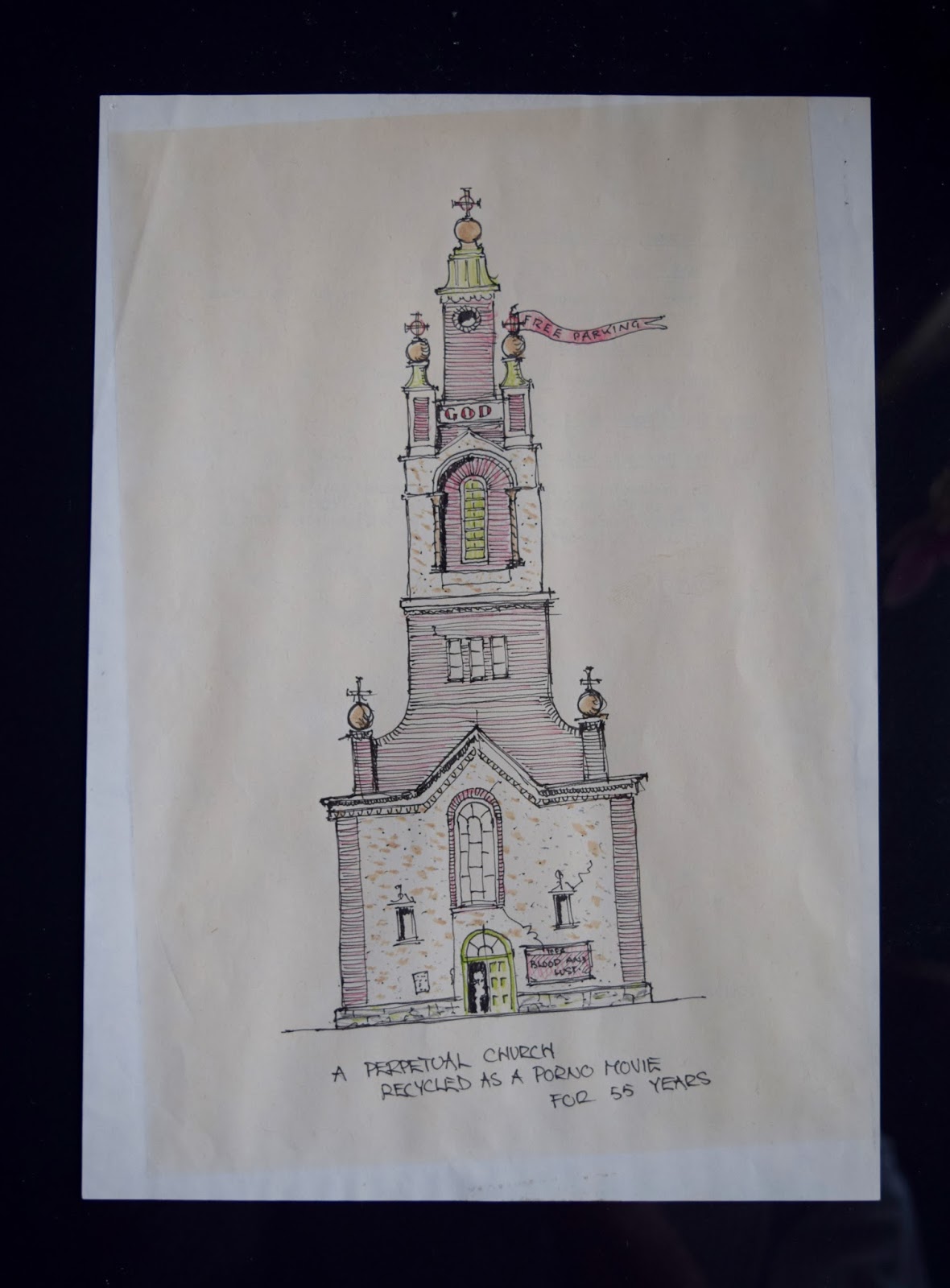
That board meeting stands out in my memory as the first time I made a “policy” pitch to the members of the Ontario Heritage Foundation (I argued for the 99 year option).  One of those members was Anthony (Tony) Adamson, a restoration architect and co-author of Hallowed Walls.  While having his say in the churches discussion, Tony amused himself doing what architects often do — doodling.  On the back of an agenda paper, retrieved by me later as a souvenir of the day, here is what he drew.

Anthony Adamson's sketch of a church, created during a 1980 OHF board meeting


Tony Adamson’s comical sketch, whimsically captioned “A perpetual church recycled as a porno movie [house] for 55 years”, suggests not just the provincial debate about the term of church easements but also the issue of the adaptive re-use of redundant churches.  More on this and the particular predicament of our heritage places of worship next time.

Note 1: The Official Plan covers all of the county with the exception of Stratford and St. Marys, which have their own OPs.  The list of cultural heritage sites dates from the last update in 2007.

Thursday, August 13, 2015

Churches -- a country tour


Rose window, St. Patrick's, Kinkora


Another Ontario heritage anniversary.  Forty years ago, in 1975, Marion MacRae and Anthony Adamson published their groundbreaking Hallowed Walls: Church Architecture of Upper Canada.  In the Prelude they wrote:

They had … faith and they built for it, places of worship which were temples of the spirit, social centres of the growing communities and, all too frequently, the only buildings in which they could afford the luxury of beautiful space.  It would be an irreparable mistake to let buildings which played so vital a role in the social history of the province disappear without record or comment.


Churches, places of worship — for the preservationist another weighty topic, right?  So let’s ease into it.  I’ll start by taking you on a little pictorial tour of three country churches in this part of the world (Perth County).  Unlike many, these churches — or at least the buildings — seem to be doing just fine.

Avonbank Presbyterian Church

One of my favourites, this little church is in a tiny place called Avonbank (not to be confused with nearby Avonton, and certainly not Avonlea!).  Constructed in 1890 as a Presbyterian church, it has a quiet simplicity and grace.  Its congregation long ago combined with that of Motherwell Presbyterian, a few miles away, and the building today is used rarely — for one annual service, a candlelight carol celebration at Christmas and for the odd wedding or special event.  But, as you see, it is well-maintained and someone has planted the flower pots beside the door.

The adjacent cemetery has four very handsome fieldstone gateposts.  These are from 1929, which seems to have been a time, in these parts at least, when the second and third generations began to publicly commemorate the achievements of their settler forbears.  The sentiments this evoked are beautifully captured on plaques on two of the gateposts.


Several miles to the north, on Highway 8 — the old Huron Road — is Seebach’s Hill and First St. John’s Lutheran Church.


First St. John's Lutheran Church, Seebach's Hill, with cemetery entrance and corner of buggy barn to right

The church, built in 1927, replaced earlier ones on the site.  It too has a cemetery (special to me because my Schneider great-grandparents are buried there).  Note that the cemetery entrance, visible to the right, has very similar fieldstone gateposts to Avonbank’s — the same craftsman? — this time with the date 1931.


But the really remarkable thing about Seebach’s Hill is the church’s old buggy barn.  I have never seen one like it.


Old buggy barn, St. John's Lutheran Church, Seebach's Hill

The huge barn — 260 by 54 feet! — clearly belonged to the old church but has somehow survived and become… a car barn.  How many other rural churches do you know that have covered parking?  And, by the way, is this still religious heritage or something else?  Is this a case of adaptive re-use or just continued use accommodating changing technology?


Buggy barn interior

Just up the road, on the way to our last stop in Kinkora, we’ll stop to admire the striking circular cairn to Andrew and Eva Seebach.  Seebach — like Sebastian Fryfogel, who built the iconic Fryfogel Tavern to the east of Stratford — had one of the early settler inns on the Huron Road.  Mmmn… more fieldstone work, dated 1928, the centenary of the opening of the Huron Road and the Seebachs’ arrival here.

Seebach cairn

A couple miles north, almost lost in the cornfields, is the quiet hamlet of Kinkora — in Gaelic Kinkora means “place of beauty.”  While the Roman Catholic church here is, not surprisingly, St. Patrick’s, what is surprising is the grandeur of the church.  It’s a stunner!


St. Patrick's Roman Catholic Church, Kinkora

The church, from 1882, is in fact the work of noted Ontario ecclesiastical architect Joseph Connolly.  Connolly is perhaps best known for the majestic Basilica of Our Lady Immaculate that dominates downtown Guelph.  How the local Irish farming community managed to lure Connolly to this unlikely spot — and pay for this sumptuous building — is a story I have yet to discover.  Unlike the limestone Guelph church, Kinkora is of brick, in polychromatic High Victorian Gothic.  The interior is sublime and and the building has a very pretty separate side chapel.  Alas, the spire on the tower, visible for miles across these flatlands, had to be taken down a decade or so ago, although there are hopes it may be reconstructed.


Several years back, after the church was part of a local Doors Open, attracting a wider audience and more attention, St. Patrick’s received an award from Architectural Conservancy Ontario for the efforts of the parish in restoring and maintaining this marvellous structure.  Talk about the “luxury of beautiful space.”

St. Patrick's, Kinkora interior

These three churches — and their associated cemeteries, gates and buggy barns — are lucky to survive and continue to be lovingly preserved by their communities.  None is listed or designated under the Ontario Heritage Act.  Should they be?  Of course — we’ll get into this and more thoughts on the protection and preservation of religious heritage next time.


Quatrefoil stained glass window, St. Patrick's, Kinkora

By the way… thanks for reading!

Monday, July 27, 2015

Protecting municipally-owned heritage (part two)

When we looked at the need for policies to protect heritage property owned by the province, we saw that the demolition of the old lunatic asylum in Toronto in 1976 was perhaps a watershed moment (see “Policies for the protection of provincially-owned property (part one)”, from May 31, 2015).

In the case of municipally-owned heritage, there are a couple losses that loom particularly large in the last 50 or so years.  The first was in Kitchener, where the splendid 1920s classical revival-style city hall was demolished in 1973.  The building presided over a great civic square, which was also lost — both replaced with a non-descript mall. (Note 1)


Old city hall and civic square, Kitchener


The other was in Chatham in 1981 when the grand old Harrison Hall, Chatham’s city hall, fell to the wrecker’s ball.  I remember the consternation this caused at the culture ministry in Toronto at the time.  The OHA had been passed in 1975 and the revamped Ontario Heritage Foundation (now Ontario Heritage Trust) had grant money for preservation projects.  But despite provincial and local efforts, council was not persuadable.  Again, a mall rose from the ashes.


Harrison Hall, Chatham


Then there are the famous “they-beat-back-the-philistines” stories from the 1960s and ‘70s — the saving of old city hall in Toronto is the best known.  (In this case another downtown mall, the Eaton Centre, did not end up swallowing the building.)  The 1899 neo-Jacobean (or Picturesque, take your pick) city hall in Stratford, and its triangular civic “square”, also narrowly escaped destruction in this period. (Note 2)


Stratford City Hall from the rear showing part of Market Square


More recently, we have seen notable successes in rescuing civic buildings that were at risk, often as a result of amalgamations.  My favourite is Victoria Jubilee Hall — the fight to save Walkerton’s old town hall gave birth to the local branch of Architectural Conservancy Ontario and ACO now owns the building.


Victoria Jubilee Hall, Walkerton (you can probably guess its date of construction)


What do we learn from all this about how to protect municipally-owned heritage?

First, use of listing and designation is crucial.  Even more so than with private property, as municipalities should be leading by example.  Listing flags a heritage property and provides interim protection.  Designation provides long-term protection.  While it’s true, as we saw last time, that with these powers the municipality ultimately controls the levers, it must still follow the process set out in the OHA.  It must at least consult with, and consider the advice of, its municipal heritage committee.  In the case of de-designation (almost always a bad idea), its actions are also subject to review by the Conservation Review Board if there are objections (which there almost always will be).  While it cannot be appealed, demolition of a designated structure is not something any city, town or township would contemplate lightly.  Even alterations will be subject to sharp scrutiny.  Here in St. Marys the Town proposed removal of a chimney of the designated town hall, creating a big fuss — and hasty back-pedalling.

Heritage district designation can be a powerful way of protecting and enhancing the municipally-owned “public realm” of an area — the streets, sidewalks, verges, etc. that contribute to its unique character.  (Alternatively, or in combination with an HCD, some municipalities, like Kingston, use area-specific Official Plan policies for this purpose.)

Second, the importance of strong heritage policies in the municipality’s Official Plan — deriving from and building on those in the Provincial Policy Statement.  These should include special additional policies that apply to heritage property in municipal ownership and public realm property.  Here are two examples from Toronto’s recently adopted OP heritage policies:

  • When a City-owned property on the Heritage Register is no longer required for its current use, the City will demonstrate excellence in the conservation, maintenance and compatible adaptive reuse of the property.
  • When a City-owned property on the Heritage Register is sold, leased or transferred to another owner, it will be designated under the Ontario Heritage Act.  A Heritage Easement Agreement will be secured and monitored, and public access maintained to its heritage attributes, where feasible. … (Note 3)

Third, don’t expect the province to come to the rescue of civic heritage at risk.  While I would like to believe the old Kitchener City Hall and Chatham’s Harrison Hall would still be standing if the OHA had had the provincial designation and stop order powers it does today… well, that’s hypothetical, but also fanciful.  (That said, a timely provincial stop order should not totally be ruled out, and sometimes all it takes to turn the tide is a little extra time.)

Not to be overlooked is the Ontario Heritage Trust’s heritage conservation easements program, which further protects many municipally-owned structures such as Stratford City Hall and the Wellington County Courthouse in Guelph. (Note 4)  The province — both the Ministry of Tourism, Culture and Sport and the Ontario Heritage Trust — is of course also a great resource and active promoter for the municipal policies and actions discussed above.  And then… there’s provincial public infrastructure funding!

Finally, and most especially, the role of citizen vigilance and activism, which has effectively preserved so much of our civic (and non-civic) heritage, often through hard-fought battles — whether for the town hall on the square, the bridge on the river or the by-law or policy on the books.

Note 1: Kitchener’s decisions here were approved by public referendum.
Note 2: Architectural historian Douglas Richardson memorably referred to Stratford City Hall fitting into Market Square ”like a hand in a glove.”
Note 3: Policies 8 and 9 under “General Heritage Policies.”
Note 4: The Trust’s easements program is generally a reactive, rather than proactive, one, and because of funding limitations has become over the years less focussed on cultural heritage and more on natural heritage.

Next time: Churches!

Thursday, July 16, 2015

Protecting municipally-owned heritage (part one)

How much of our heritage is in municipal ownership?  Think about it — historic city/town halls, libraries, museums, parks, cemeteries (lots!), war memorials.  PUC (public utility commission) and like buildings.  And most bridges.  Don’t forget roads.  What else?

PUC building, now Festival Hydro, Stratford

Some municipally-owned properties have been acquired from other governments or agencies, often because they were redundant — old courthouses, railways stations, and railway rights-of-way are common examples.  Sometimes surplus schools too (schools are owned by school boards).


Junction Station, St. Marys -- one of two stations owned by the Town

Then there are private properties that municipalities acquire, often by expropriation, for various purposes.  The power to acquire property for “community improvement” goals under the Planning Act is well known.  (Believe-it-or-not there is even a power under the Ontario Heritage Act to expropriate property for heritage conservation objectives, but this has been used, to my knowledge, only once, in Amherstburg in the early ‘80s.)  In many cases these are “pass through” properties that are later sold back to the private sector or another broader public sector owner.

In the arsenal of tools to protect cultural heritage resources at risk, public ownership is touted as an important one.  The idea that, relative to an irresponsible private owner, a public owner will be better disposed to recognize the public interest in preserving the property or better able to marshall the resources to do so, or both, is — in general — true.

At the same time we all know that public ownership provides no guarantee of enlightened stewardship of heritage sites — especially in a time of ever greater belt-tightening.  And so there is need for good policies and other measures to provide some assurance this will happen.

For municipally-owned sites, what are these?  Well, first, the Provincial Policy Statement (PPS), issued under section 3 of the Planning Act, which unequivocally directs that “significant” cultural heritage resources be conserved (section 2.6).  As a statement of overarching provincial policy objectives, the PPS is a powerful instrument, and, as intended, can be quite effective in prompting municipalities and other authorities to adopt what might be considered subordinate, implementing policies and actions to protect cultural heritage.  These measures include strong Official Plan policies and the use of tools provided in the Ontario Heritage Act and other legislation.

Reliance on the PPS to protect specific properties, however, would be problematic.  For one thing, it is triggered only with respect to a “planning matter” — arguably how a town, say, preserves (or not) the cultural heritage values of its Carnegie library falls outside its purview. (Note 1)

Designation under the OHA is the usual way of protecting heritage property in municipal hands.  Municipalities are in fact much more likely to designate their own properties than to designate private property, especially where the owner is reluctant.

But in this situation heritage designation is less secure than usual.  Inherent in the (largely) decentralized system created by Ontario Heritage Act is the idea that the decisions about a community’s heritage rest with the local municipal council.  However, where the municipality is also the owner of the heritage property in question… well, you can see how a council might be conflicted.  When faced with a recommendation from its municipal heritage committee to designate a library, for example, the council may choose to designate, or, for self-interested reasons, decide not to.  Or, having designated, the council may decide to approve whatever alteration or demolition the municipality wants to make.  Or even to de-designate.  A cynic might say it looks a little like the fox guarding the hen-house!

Some jurisdictions have a body separate from municipal council — usually a preservation board like the New York City Landmarks Preservation Commission — that decides on designations and approves changes to protected property.  (Over the years there have been suggestions that municipal heritage committees, which are advisory only, should be beefed up and assume similar powers.)

Enough for today… more next time.

Note 1: The PPS has other limitations: the qualifier “significant” in the section 2.6 policies is problematic; and there is also the “read it as a whole” injunction which in practice may have the effect of weakening any one specific policy.  For another day.

Wednesday, July 1, 2015

Carnegie libraries, our communities' public buildings ... and Alice Munro?

This rambling “policy story” begins in my hometown of Milverton, Ontario, north of Stratford — on the edge, as I now like to say, of Alice Munro Country.  And speaking of things literary, like many small and not-so-small towns Milverton has a Carnegie library.


Former Milverton library


Built in 1909 this stately structure saw a century of service from 1910 until it closed in 2011.  I loved the old library as a kid — it was the grandest public building in town (village actually, population about 1100). That impressive flight of stairs, from the top of which which you looked down and across Main Street and further down a street that ran up to the library.  (I didn’t know what an axial view was then, just that it was special.)  The comforting, almost reverential feeling inside — the high-ceilinged rooms with all those books and, of course, the pervasive quiet.  I can still see the shelf where the Oz books resided, and the one with the Hardy Boys books too… but I digress.

The library was also the town hall — the village council met for decades in the lower storey of the building.  In the amalgamation wave that swept the province in the late 1990s Milverton joined with four neighbouring townships to become the Township of Perth East.  The new township needed a new municipal building (I know, doesn’t sound as good as town hall, does it?), and later a new library.

But let’s go back a ways to get the bigger picture — and this brings more public buildings, namely schools, into the mix.  In a tale of dominoes all too common in our communities, here is what happened in Milverton.  The late 1960s-early 1970s saw an earlier amalgamation tide hit Ontario schools, and the Milverton high school was closed (and students bussed to Stratford and Listowel).  But the building was at least re-used as the area public school, although that resulted in the closure of smaller schools round about.  The old, handsome but decrepit Milverton public school became for a while the village/township hall and the council met there instead of the library.  Then the new municipality demolished the old school and built its new municipal offices, which of course also meant that the four former township halls were made surplus.  And then the library was replaced with a new one on a different site, leaving the old building intact but surplus, its fate uncertain too.

Now many municipalities have done a great job of keeping their Carnegie libraries and adapting them to meet current needs.  (Bear with me, I’ll get to the point of all this, eventually).  For example — Brussels, Ontario, in the present Township of Huron East (and the heart of Alice Munro Country), recently enlarged and renovated its Carnegie library, which is the same age as Milverton’s and has some stylistic similarities.  Local architect John Rutledge designed a sympathetic addition while sensitively refurbishing the original building.  When I visited it last month the librarian said that Alice Munro had toured the library the week before and really liked it.  Reminds me that the Wingham library, also a heritage building, was just renamed to honour our Nobel Prize winner… but getting sidetracked again.


Old postcard -- sorry don't have pic after major renewal 

But the Brussels approach would not have worked in Milverton.  More space was needed and, as the photo shows, the site was confined, with houses on either side.  And all those steps — wonderful for views, yes; for accessibility, not so much.  Parking also in short supply.  The new library solved these issues.

It seemed for a while like the old library was at risk.  Our local Architectural Conservancy Ontario branch was concerned.  But fortunately it was purchased by an individual who uses it as a residence and office and is maintaining it nicely.  From public library to private home... but apparently a good example of adaptive re-use.

Did I mention that none of the public (in one case now private) buildings I’ve mentioned is designated under the Ontario Heritage Act?

Next week: protecting municipally-owned heritage