Thursday, October 22, 2015

The OHA: what the courts have to say (part one) ... or, when moveables become immoveables

Our topic for today — please don’t be scared away — 
Is what the courts have had to say…
about the O-H-A.

AKA jurisprudence: how the courts and, from a wider perspective, our regulatory tribunals — the Ontario Municipal Board and the Conservation Review Board — have interpreted the Act and its regulations.

As we saw last time, during debate over Bill 60 ten years ago, a group of church organizations claimed that the legislation — specifically the controls on demolition of designated buildings — was unconstitutional because it violated the right to freedom of religion under the Canadian Charter of Rights and Freedoms.  Although the bill was passed into law unaltered, no challenge of the kind was, thankfully, ever pursued.  Would have made for a fascinating case though.  Imagine the courtroom drama!  And then the excitement of the court’s decision — the Act (demo provisions) upheld… or the Act struck down… or the Act struck down for faith group owners but upheld for everyone else. [Note 1]

Not complaining, but there hasn’t been much courtroom, let alone courtroom drama, associated with the OHA.  For a statute that’s been around for 40 years there are remarkably few court decisions.  Probably this is because the legislation was, until Bill 60 came along, relatively weak, so property owners (the most likely challengers) didn’t see much at stake.  Also that the two tribunals involved have, as intended, borne the brunt of what disputes there have been — and have handled these competently, with few errors in law that would open the door to review by the courts.

But there have been some interesting cases, and I’m not counting those that turned on procedural points like whether notice of designation was properly given or not.  Let’s look at one, just decided this month: Foley v. Corp. of the Town of St. Marys. [Note 2]

Andrews Jeweller building during shooting of Murdoch Mysteries episode, 2014

The case concerns the iconic Andrews Jeweller building in downtown St. Marys.  The 1884 building is in the middle of a heritage conservation district but is also individually designated — outside and in.  And it’s the “in” that led to the dispute here.

The designation by-law, from 2008, covers the building exterior and “all of the original interior features” from 1884.  While these are not spelled out, the by-law has a schedule attached with photos of the interior, and the photos, not unlike the historical one reproduced here (although minus the jewellery!), show a wall clock, walnut cabinets and counters, and mirrors.

Interior of Andrews Jewellery store, courtesy St. Marys Museum

The owners argued that these features were chattels or personal property, not real property, and that their designation was invalid, since only “real property” including “all buildings and structures thereon” can be designated under the Act.

The back story here is that the out-of-town owners have been trying to sell the building for years and are convinced that the restrictions on the truly gorgeous interior are scaring off buyers.  [Note 3]  After attempting in vain to get the Town to remove the designation of the interior, they sought redress from a higher power.

So the court was faced with the question — were the clock, cabinets, etc. personal property (not designatable), or were they fixtures, part of the real property (designatable)?  In a different lexicon, moveables or immoveables?

From the leading cases on the distinction between chattels and fixtures, the court identified two principles as germane to the case:
  1. an object that is only attached to a building by its own weight is not part of the real property unless there is evidence to show it was intended to be part of the building
  2. an object is considered a chattel unless there is evidence it is affixed with the intention of improving the property or premises as a whole
Now the wall clock in the Andrews Jeweller building could simply be lifted off its hook, and this had been done for cleaning purposes.  The counters were just sitting on the floor.  Removal of the cabinets and mirrors would be more difficult but could be done without damage.

Nevertheless… the court concluded they were all fixtures:

The evidence establishes that they were designed and installed for the express purpose of attracting customers and selling jewellery through an enhancement of the realty.  The wall clock, cabinets and counters were purposefully designed and built into the store for a specific purpose.  They were used for that purpose and never moved again in over 100 years.

And so the owners’ suit miscarried.

A sensible result.  It seems the test is not (the simpler) one of how easy a heritage element can be removed, but (the harder) one of intention and purpose of its installation.

I guess you could say that when it comes to designating interior features, you don't necessarily have to nail it to nail it.  (Sorry.)

I’ll leave you to ponder the implications for other old stores and their counters and shelves, for old churches and their alters and pews, for old town halls with their wallclocks and furniture… et cetera.  Does it matter if these things weren’t "original" but added later?

Andrews Jewellery building during shooting of Murdoch Mysteries, 2014

Note 1: In drafting Bill 60 the culture ministry sought a legal opinion on whether proposed tougher demolition controls would hold up and was advised to include “no compensation” provisions (OHA section 68.3); but compliance with the Charter was not considered. 

Note 2: Superior Court of Justice File No. — 15-2635; dated October 9, 2015.  http://www.canlii.org/en/on/onsc/doc/2015/2015onsc6214/2015onsc6214.html
The lawyer successfully arguing the Town's case was Eileen P.K. Costello, of the Toronto firm of Aird & Berlin. Note: The owners appealed the decision but the Court of Appeal dismissed the appeal on a technicality in June 2016.

Note 3: The designation certainly didn't scare off CBC's Murdoch Mysteries when it came to town a year ago to shoot two episodes of their series, one involving a gang of female jewel thieves. The Andrews building, both inside and out, played... a jewellery store.

Friday, October 9, 2015

The churches versus Bill 60

Okay, deep breath…

In this country the separation of church and state is a given — even if the two occasionally find themselves at odds.  Unlike earlier times when the “established church” exerted a domineering influence on government policy, today it is usually the government that is accused of trespassing on matters of faith and trampling religious freedoms.  The current controversy in Ontario over a new sex-ed curriculum in schools is one example.  The wearing of the niqab at citizenship ceremonies and in the public service, now (shamefully) a hot-button federal election issue, is another.

Heritage policy in this province has seen its own dramatic church/state divide.  In the first post of this blog I tell the story, from an inside-government perspective, of the long years of effort spanning four governments to overhaul the Ontario Heritage Act.  Finally, legislation, known as Bill 60, was introduced in the Legislature in the spring of 2004.  I blamed the delay in its passage on trouble with church organizations:

A year later, delayed by a fierce eleventh hour assault by certain faith groups intent on diluting the legislation, … the new Act was passed and given Royal Assent on April 28, 2005.

What happened there?  Why the “assault”, how was it turned back, and what was the fallout?

To go back a ways…  It is elementary that the making of good public policy requires consultation with stakeholders — with those who have an interest in or may be affected by a new policy.  The enormous and exhaustive public consultation process on heritage policy and legislation undertaken in the late 1980s included church groups (frankly it would be hard to think of a sector it didn’t reach out to).  From what I recall, faith organizations did not have much to say.  Nor when the various reports and recommendations for heritage policy and legislation were released in the early 1990s.

But later, for a decade, nothing much happened, at least that was visible from outside the culture ministry.  Then, suddenly — from the standpoint of someone not paying much heed — there was a bill before the House!  And on the first reading of a bill it becomes public, and starts to get attention.  And (one hopes, since this is the purpose of our legislative process) real scrutiny.

Of course, when the governments of the day (early 2000s) — Conservative first, then Liberal — at last got engaged in reviving reform of the Ontario Heritage Act, they wanted assurance stakeholders were in support.  In view of the long history, direction was given to consult expeditiously with three key interest groups: municipalities, heritage organizations and the development industry.  The culture ministry brought these sectors, as well as other provincial ministries, on side.  Legislation was drafted and by April 2004 Bill 60 was launched.  Second Reading took place in September and the finish line was in sight.  

As best I can tell, it was about that time the bill caught the eye of a law firm representing the Roman Catholic Archdiocese of Toronto.  Not long after all hell broke loose.

Led by the Archdiocese, a coalition of Christian churches objected strenuously to the bill, especially the strong demolition control provisions, which they saw as unfairly limiting their ability to alter/demolish/sell redundant church property.  They said — with some justification — they had not been consulted.  They even claimed the legislation would infringe their Charter rights, backed up with a legal opinion that it was likely unconstitutional!  Yikes.

At the committee hearings on the bill a formidable delegation of church representatives inveighed against it.  The bill cleared committee, but…  the Archbishop of Toronto had called the Premier’s Office.  At the ministry we knew we had a BIG problem.

To address the concerns, the government agreed to create a working group of church organization and ministry/Ontario Heritage Trust representatives.  Pending recommendations from this group the bill would be stalled.  At the beginning of 2005 the group worked feverishly and, on a number of lesser issues, such as the proposal for provincial criteria for heritage designation, made progress (mainly by bringing the faith groups to a better understanding of the bill’s provisions).  But on the main bone of contention — permanent demolition controls, the lynchpin of the whole reform exercise — there was an impasse.

The faith groups would go along with strengthened controls on demolition but insisted that their exercise by municipalities be tempered by a list of “factors”, the key one being the financial circumstances of the property owner.  They preferred this be done via a regulation that mandated consideration of the factors, and that the bill be amended to provide for the development of such a regulation.  The ministry/OHT reps, on the other hand, were prepared to go only so far as to commit to a wider public consultation on the question after the bill was passed.

What would the government do?  Weeks passed, then months.  It seemed like the whole thing was about to go down the proverbial drain.  Heritage groups and some municipalities, hearing whispers of behind-the-scenes drama, called for the bill to move forward.  Then, in April 2005, the word came down — Bill 60 would be called for Third (and final) Reading.

The end?  No, only the beginning of a very long end to the standoff.  Later that year the ministry carried through on its agreement to consult on factors to be applied in decisions by municipal councils (and, on appeal, the Ontario Municipal Board) and the results were predictable — the faith groups wanted them, virtually everyone else didn’t.  A “compromise” proposal to implement the factors through an unprecedented formal ministry guideline instead of a regulation was (thankfully) vetoed by Minister Madeleine Meilleur.


But the government had to do something.  We looked at these initiatives last time.  First, in 2006 the minister announced $1 million in funding to the Ontario Heritage Trust for the development of a comprehensive inventory of Ontario’s places of worship.  More recently — after years of continued badgering — the culture ministry created a working committee of faith groups, heritage professionals and municipal staff to grabble with the outstanding issues, work that resulted in a Heritage Tool Kit guide on conserving heritage places of worship.

And perhaps also since time has gone by and the results of Bill 60 for religious properties have not been as dire as some faith groups feared, this particular church/state policy squabble seems at last to have died away.

Friday, September 25, 2015

What to do about churches? (part three)

Stained glass dome, Highgate United Church, now Mary Webb
Cultural and Community Centre, Highgate 

There’s something else about churches…  

Back to basics for a minute.  Built heritage conservation is not supposed to be about use (as long as there is a viable one of course!).  So whether an old factory is used for its original industrial purpose, adapted for commercial use or turned into chic condos is all the same — right? — provided its heritage features are identified and respected along the way.  Heritage is about the fabric or “bricks-and-mortar,” the physical features of the place; while what takes place within/on that fabric/property — the way it is used — is pretty much irrelevant.

This at any rate is the premise of our chief tools for legal protection — heritage designation and heritage easements under the OHA.  They do not in themselves restrict (or permit) the use that can be made of a property or place.  Zoning, our basic land use planning mechanism, does that.

And yet, we do accept that a heritage structure continuing in its original use is the best of all scenarios.  From the Appleton Charter:

Use — A property should be used for its original purpose. If this is not feasible, every reasonable effort shall be made to find a compatible use which requires minimal alteration. … [Note 1]

So continuing original use is almost always preferable to adaptive re-use.  Why?  Obviously it’s simpler, less complicated.  Adaptive re-use involves, well, adaptation and intervention — physical changes which may have an impact on heritage attributes.  But it’s more than that.  Something else inevitably melts away when an old building is repurposed (as we now like to say) and its traditional use ends.  Something intangible.  Hard therefore to nail down, but having to do with a heightened sense of place, nearness of the past, consciousness of continuity.  Sometimes we call this, rather inadequately I think, authenticity.

Nowhere is this more the case than with churches, places of worship, places where generations of people have come together as a community to celebrate their faith.  A church repurposed, even to the highest conservation standards, can’t help but be a shell of what it was… you could go so far as to say its “soul” has been lost. [Note 2]

Indulging the metaphor, this may help explain the reluctance of some faith organizations to save the “body” (the fabric) when the “soul” (the spiritual focus) of a building is no more.  Unfortunately they sometimes choose to overlook the possibility that their place of worship could continue to serve as another group’s place of worship.

St. George's Greek Orthodox Church, formerly a synagogue (Holy Blossom Temple), Toronto


For public policy, all this suggests that special measures should be considered to keep heritage places of worship as just that — places to worship — as well as to help overcome barriers to adaptive re-use when that’s not possible.  What might these be?

To start, tax-exempt status clearly benefits continuing use by faith organizations and should be maintained.  To facilitate ongoing use, heritage restrictions must be applied very gingerly, especially when it comes to alterations for liturgical reasons and for meeting a congregation's current needs.  But to really improve things there needs to be meaningful financial incentives to help with religious building conservation — to fix that roof! — incentives which Ontario, unlike Quebec, currently (and for way too long) doesn't have.  [Note 3]

But lately Ontario has been doing some things well.  Inventories of course are vital and, at the provincial level, the Ontario Heritage Trust has compiled a mammoth and ongoing on-line inventory of Ontario’s places of worship.  The Ministry of Tourism, Culture and Sport, for its part, recently added a guide to preserving and protecting religious properties to its popular Ontario Heritage Tool Kit.  [Note 4]


After many, many years of doing bubkas for churches, what was the spur for these provincial initiatives?  Therein lies quite a tale… for next time.


Note 1: The Appleton Charter for the Protection and Enhancement of the Built Environment, ICOMOS Canada (English-Speaking Committee), 1983.

Note 2: The Ontario Heritage Act defines “heritage attributes” (a term used in the Act only in the context of heritage designation) narrowly: “in relation to real property, and to the buildings and structures on the real property, the attributes of the property, buildings and structures that contribute to their cultural heritage value or interest.”  Use is not mentioned, nor does the word appear in the designation criteria in Reg. 9/06 and 10/06.

By contrast, the non-legislative Standards and Guidelines for the Conservation of Historic Places in Canada takes a broader, looser approach, defining “character-defining elements” as “the materials, forms, location, spatial configurations, uses and cultural associations or meanings that contribute to the heritage value of an historic place, which must be retained in order to preserve its heritage value” (underlining added).  

Note 3: In the last 20 years the Quebec government has funnelled close to $300 million to the Conseil du patrimoine religieux du Quebec for the safeguarding of that province's religious heritage (both immoveable and moveable).  The last time the Ontario government had a grant program targeted to built heritage conservation, including churches, was the Heritage Challenge Fund of 1999-2001, which provided just five million dollars on a matching basis for the whole province.  

Note 4:  Check out the Trust's inventory here: 
http://www.heritagetrust.on.ca/Ontario-s-Places-of-Worship/Home.aspx?lang=en-CA. The site includes a few case studies — with hopefully more to come — and some good links.  The ministry's guide, "Heritage Places of Worship: A Guide to Conserving Heritage Places of Worship in Ontario Communities", can be found at: http://www.mtc.gov.on.ca/en/publications/Heritage_Tool_Kit_POW.pdf.

In 2009 the Trust also organized, with Heritage Canada (now the National Trust for Canada), an important roundtable on the preservation of places of faith. The roundtable minutes are at:
http://www.nationaltrustcanada.ca/sites/heritagecanada.org/files/National%20Places%20of%20Faith%20Roundtable%20Minutes.pdf. One of the most interesting presentations profiled Partners for Sacred Places, a U.S. organization that provides information and guidance to congregations and communities to sustain use of historic sacred places: http://www.sacredplaces.org.

Saturday, September 12, 2015

What to do about churches? (part two)


Shaar Hashomayim synagogue, Windsor -- with Doors Open balloons 


We’ve been talking about churches — or more broadly, places of worship of all descriptions — and wondering how public policy should respond to the conservation dilemma they pose.  But first we need to better understand their special circumstances.

My first experience with the preservation of a church was in 1979 when I was a summer student with the Stratford Local Architectural Conservation Advisory Committee (or LACAC — remember them?).  There was a call from someone from Trinity Anglican Church in the village Sebringville, just west of Stratford.  The congregation wanted advice on something.  While Sebringville was “out of our jurisdiction”, Stratford’s was the only nearby LACAC and I was sent out to have a look.  What I saw was a beautiful little white board-and-batten, “carpenter gothic” building from 1887.

Trinity Anglican Church, Sebringville   Courtesy Fanshawe Pioneer Village


I don’t recall exactly what the parish was thinking to do… but it was something rather awful.  Could it have been — gasp — a dreadful plan to replace the board-and-batten with aluminum siding?  Whatever it was, we helped talk them out of it, arguing for retention of its historic appearance and repair of original features rather than removal or covering up.  By 1988 the building’s heritage value was formally recognized and it was designated under the Ontario Heritage Act.

But… by 1997 the dwindled congregation voted to close the church.  It looked like demolition was at hand.  In the end the building was moved from its site on Highway 8 (the old Huron Road) about 55 km south to Fanshawe Pioneer Village, on the north side of London, where it continues in use for weddings and other special events.

Trinity Church on the move, in three parts   Courtesy Fanshawe Pioneer Village


Like all buildings moved out of their original surroundings and relocated to a “pioneer village” — an artificial and sometimes haphazard arrangement of collected orphaned buildings — Trinity today evokes mixed feelings.  But though its context has been lost, the church itself was saved — unlike many! — and, now in public ownership, it continues to be cared for, used and interpreted. [Note 1]

It sure seems like our historic places of worship have more than their fair share of challenges.  The main thing of course is declining congregations and attendance and the desire for smaller, lower maintenance buildings and often different, less formal meeting spaces.  And then, when worship wanes, there are the typically formidable obstacles to adaptive re-use of the buildings.  These can be attitudinal —  certain faith organizations would rather have their churches deconsecrated and destroyed than sold and re-used for an unpredictable and, in their view, unsavoury secular purpose… remember the “porno movie house” cartoon from last time?  But mainly it’s the sheer physical challenge of re-purposing the large open interiors of many churches.  (The small, rural ones tend to be easier — who hasn't known someone who lived in an old church?)

Adding to the adaptive re-use complications is that these interiors are special!  Unlike most heritage homes, commercial blocks or factories, the historic church/synagogue/ mosque/temple is usually as significant inside as outside.  Which is why designations and heritage easements on these buildings almost always cover interior features as well.

Interior of the Church of Our Lady Immaculate, Guelph

Interior of Romanian Orthodox Church, Windsor


While we’re talking of church interiors — not to be forgotten is the point that religious buildings that continue as places of worship may require changes for liturgical reasons over time, and this can give rise to tension with heritage conservation.

Then there’s the fact that ownership and control of houses of worship varies considerably, with some faith organizations much more centralized (like the Roman Catholic Church) and some much less so (like the United Church).

So… lots of ways in which places of worship are special, if not unique.  And here’s yet a couple more to keep in mind — they’re exempt from property tax; and faith groups as non-profit organizations are generally exempt from income taxes as well.

Does all this add up to the need for distinct policy responses for the conservation of Ontario churches?  Of course.  Last time we saw an instance of this when the Ontario Heritage Foundation (now OHT) bent the rules on its conservation easements program to accommodate the particular concerns of church organizations.  But what else has been done — or not done?  For next time.


Note 1: The church may have been moved, but not the designation, which had to repealed when the building left Sebringville.  It has not been re-designated on its current site.

Thursday, August 27, 2015

What to do about churches? (part one)

St. Patrick's Church, Kinkora

The beautiful country churches we saw on the tour last time are not listed or designated under the Ontario Heritage Act.  Interestingly, however, St. Patrick’s, Kinkora, is designated as one of seven “cultural heritage locations” under the County of Perth’s Official Plan. (Note 1)

Is it just me or does the inclusion of a definitive list of cultural heritage sites in an Official Plan seem like a bad idea?  At the same time it’s a bit shocking that there are only seven — three of them churches — in the whole county.  (Reminds me of the Woody Allen joke at the beginning of Annie Hall where a hotel guest says, “The food here is terrible!”, and her friend replies, “Yes, and such small portions.”)

Something else jumps out.  The Official Plan says:

All alterations to, or demolitions of, buildings, structures and sites designated "Cultural Heritage", or designated under the Ontario Heritage Act, must receive approval of the local municipal Council.

Mmmn… this means that alteration or demolition of St. Patrick’s, which is on the list but not designated under the OHA, would nonetheless require the approval of the local council.  Almost certainly not kosher!  The courts have frowned on municipalities using Official Plans to regulate property when they have specific legislative tools to do so, something we’ll look at in a future post for its implications for heritage protection.

But back to churches.  And the question of how public policy in Ontario has responded to the challenges to their preservation.

Maybe we start here…  it’s 1980 and the board of the Ontario Heritage Foundation (now the Ontario Heritage Trust) is meeting in Toronto.  I’m in the room as a new staff member.  The board is wrestling, again, with a particularly thorny question — what to do about the adamant refusal of churches, or rather their owners, to accept OHF grant money for restoration and repair.  While eager for the funding, the church owners won't agree to a major condition that comes with it: that they enter into a heritage conservation easement agreement with the OHF for a very long term, the longest in fact — perpetuity.

Some context.  The Foundation’s innovative easements program had been steaming along pretty happily since it was set up following the passage of the Ontario Heritage Act in 1975, when the OHF and municipalities got the ability to acquire heritage easements.  The program went hand-in-hand with the Foundation’s then-healthy capital grants program.  Beyond undertaking to do funded work according to conservation principles, recipients of grants also had to agree to certain conditions designed to protect the property (and the public investment in it) into the future.  These were typically municipal designation and an OHF easement.  Remember that not until 2005 did municipal designation permanently protect against demolition.  By contrast, the heritage easement mechanism was air-tight in that respect, and the Foundation’s standard agreement provided that it would run “in perpetuity.”

But, though it may seem a little ironic, church organizations did not at all like the idea of “forever” when it came to agreements limiting what they could do with their buildings.  They wanted something much, much shorter — say 25 years.  (Had this idea been accepted, many of the Ontario Heritage Trust easements on churches would now have expired!)

After much debate the Foundation’s board voted in the end to make an exception for churches, and require easements for 99 years rather than in perpetuity.  Whether it was otherwise defensible to treat places of worship differently from other types of heritage property, the decision produced a good result.  Most if not all church applicants accepted the compromise and signed agreements for 99 year terms.  The money flowed and churches were saved, and protected, which might not have been. 

One of the first churches to benefit was Assumption Church in Windsor (its easement, which includes protection of the magnificent interior, would still have about 65 years left to run).


Assumption Church, Windsor

Assumption Church interior


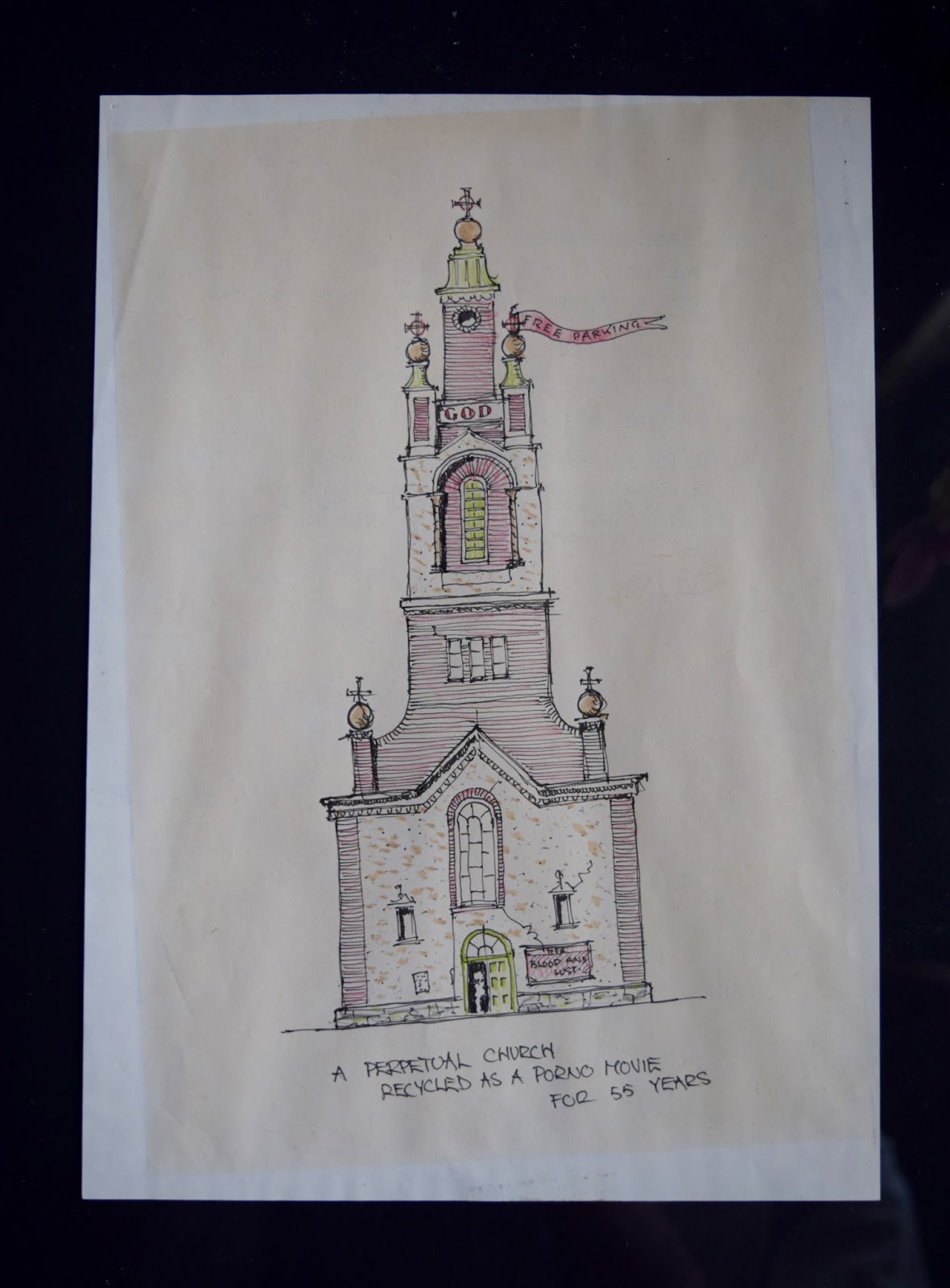
That board meeting stands out in my memory as the first time I made a “policy” pitch to the members of the Ontario Heritage Foundation (I argued for the 99 year option).  One of those members was Anthony (Tony) Adamson, a restoration architect and co-author of Hallowed Walls.  While having his say in the churches discussion, Tony amused himself doing what architects often do — doodling.  On the back of an agenda paper, retrieved by me later as a souvenir of the day, here is what he drew.

Anthony Adamson's sketch of a church, created during a 1980 OHF board meeting


Tony Adamson’s comical sketch, whimsically captioned “A perpetual church recycled as a porno movie [house] for 55 years”, suggests not just the provincial debate about the term of church easements but also the issue of the adaptive re-use of redundant churches.  More on this and the particular predicament of our heritage places of worship next time.

Note 1: The Official Plan covers all of the county with the exception of Stratford and St. Marys, which have their own OPs.  The list of cultural heritage sites dates from the last update in 2007.

Thursday, August 13, 2015

Churches -- a country tour


Rose window, St. Patrick's, Kinkora


Another Ontario heritage anniversary.  Forty years ago, in 1975, Marion MacRae and Anthony Adamson published their groundbreaking Hallowed Walls: Church Architecture of Upper Canada.  In the Prelude they wrote:

They had … faith and they built for it, places of worship which were temples of the spirit, social centres of the growing communities and, all too frequently, the only buildings in which they could afford the luxury of beautiful space.  It would be an irreparable mistake to let buildings which played so vital a role in the social history of the province disappear without record or comment.


Churches, places of worship — for the preservationist another weighty topic, right?  So let’s ease into it.  I’ll start by taking you on a little pictorial tour of three country churches in this part of the world (Perth County).  Unlike many, these churches — or at least the buildings — seem to be doing just fine.

Avonbank Presbyterian Church

One of my favourites, this little church is in a tiny place called Avonbank (not to be confused with nearby Avonton, and certainly not Avonlea!).  Constructed in 1890 as a Presbyterian church, it has a quiet simplicity and grace.  Its congregation long ago combined with that of Motherwell Presbyterian, a few miles away, and the building today is used rarely — for one annual service, a candlelight carol celebration at Christmas and for the odd wedding or special event.  But, as you see, it is well-maintained and someone has planted the flower pots beside the door.

The adjacent cemetery has four very handsome fieldstone gateposts.  These are from 1929, which seems to have been a time, in these parts at least, when the second and third generations began to publicly commemorate the achievements of their settler forbears.  The sentiments this evoked are beautifully captured on plaques on two of the gateposts.


Several miles to the north, on Highway 8 — the old Huron Road — is Seebach’s Hill and First St. John’s Lutheran Church.


First St. John's Lutheran Church, Seebach's Hill, with cemetery entrance and corner of buggy barn to right

The church, built in 1927, replaced earlier ones on the site.  It too has a cemetery (special to me because my Schneider great-grandparents are buried there).  Note that the cemetery entrance, visible to the right, has very similar fieldstone gateposts to Avonbank’s — the same craftsman? — this time with the date 1931.


But the really remarkable thing about Seebach’s Hill is the church’s old buggy barn.  I have never seen one like it.


Old buggy barn, St. John's Lutheran Church, Seebach's Hill

The huge barn — 260 by 54 feet! — clearly belonged to the old church but has somehow survived and become… a car barn.  How many other rural churches do you know that have covered parking?  And, by the way, is this still religious heritage or something else?  Is this a case of adaptive re-use or just continued use accommodating changing technology?


Buggy barn interior

Just up the road, on the way to our last stop in Kinkora, we’ll stop to admire the striking circular cairn to Andrew and Eva Seebach.  Seebach — like Sebastian Fryfogel, who built the iconic Fryfogel Tavern to the east of Stratford — had one of the early settler inns on the Huron Road.  Mmmn… more fieldstone work, dated 1928, the centenary of the opening of the Huron Road and the Seebachs’ arrival here.

Seebach cairn

A couple miles north, almost lost in the cornfields, is the quiet hamlet of Kinkora — in Gaelic Kinkora means “place of beauty.”  While the Roman Catholic church here is, not surprisingly, St. Patrick’s, what is surprising is the grandeur of the church.  It’s a stunner!


St. Patrick's Roman Catholic Church, Kinkora

The church, from 1882, is in fact the work of noted Ontario ecclesiastical architect Joseph Connolly.  Connolly is perhaps best known for the majestic Basilica of Our Lady Immaculate that dominates downtown Guelph.  How the local Irish farming community managed to lure Connolly to this unlikely spot — and pay for this sumptuous building — is a story I have yet to discover.  Unlike the limestone Guelph church, Kinkora is of brick, in polychromatic High Victorian Gothic.  The interior is sublime and and the building has a very pretty separate side chapel.  Alas, the spire on the tower, visible for miles across these flatlands, had to be taken down a decade or so ago, although there are hopes it may be reconstructed.


Several years back, after the church was part of a local Doors Open, attracting a wider audience and more attention, St. Patrick’s received an award from Architectural Conservancy Ontario for the efforts of the parish in restoring and maintaining this marvellous structure.  Talk about the “luxury of beautiful space.”

St. Patrick's, Kinkora interior

These three churches — and their associated cemeteries, gates and buggy barns — are lucky to survive and continue to be lovingly preserved by their communities.  None is listed or designated under the Ontario Heritage Act.  Should they be?  Of course — we’ll get into this and more thoughts on the protection and preservation of religious heritage next time.


Quatrefoil stained glass window, St. Patrick's, Kinkora

By the way… thanks for reading!